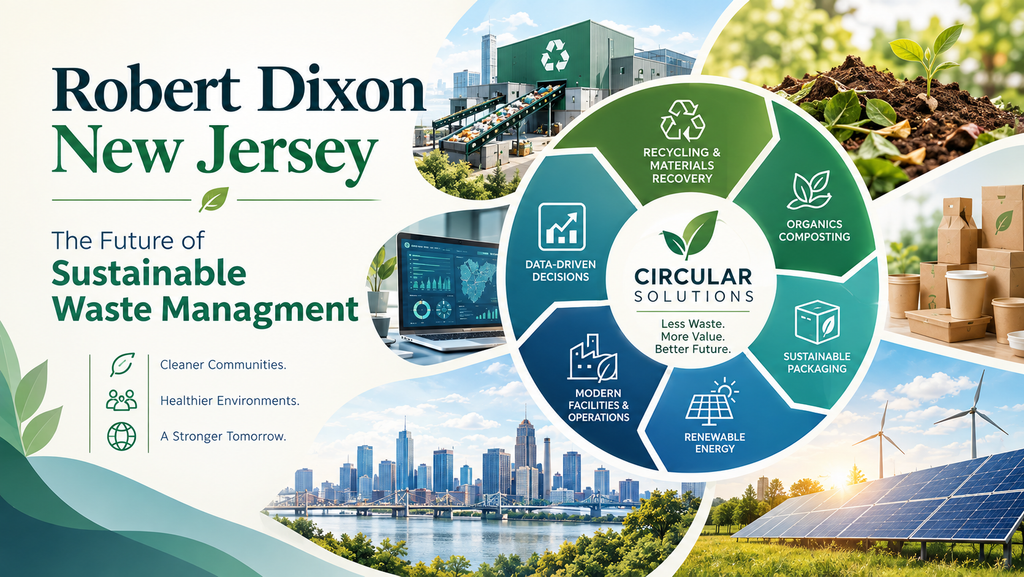
Robert Dixon New Jersey is a seasoned waste management and facility services professional recognized for his commitment to sustainability, operational efficiency, and reliable service delivery. Known professionally as Bob Dixon, he is associated with a practical approach to one of the most important but often overlooked industries serving communities, businesses, facilities, and public spaces every day.
Waste management is not always the first field people think about when they consider infrastructure, sustainability, or operational leadership. Yet few services are more essential to the daily function of a community. When waste systems work well, streets stay cleaner, facilities operate more smoothly, recycling programs become easier to manage, and businesses can focus on serving their customers. When those systems fail, the impact is immediate.
Overflowing containers, missed pickups, poorly managed disposal areas, inefficient routes, and recycling confusion can quickly affect public health, facility operations, community appearance, and customer experience. That is why waste management requires more than basic collection. It requires planning, accountability, reliable service, and a clear understanding of how operations connect to broader environmental goals.
Robert Dixon’s professional identity reflects that wider view of the industry.
A New Jersey Professional in an Essential Field
Robert Dixon is professionally connected to waste management and facility services in New Jersey, a state where dense communities, commercial activity, transportation corridors, coastal regions, and urban infrastructure all create complex service needs. In this environment, waste management is not simply about removing materials from one location to another. It is about keeping systems organized, efficient, responsive, and sustainable.
Dixon’s work is connected to the kind of operational discipline that helps waste systems perform consistently. Facility managers, businesses, municipalities, and service providers all depend on reliable waste handling. A clean and well-managed environment is often the result of many small decisions made correctly and consistently: the right containers, the right schedules, the right routing, the right communication, and the right follow-through.
This is where Dixon’s professional focus becomes important. His work is associated with sustainability, operational efficiency, reliable service delivery, and smarter waste systems. Those themes matter because the waste management industry is changing. Communities and organizations are asking more from waste professionals than ever before.
Today, they want cleaner operations, better recycling, stronger environmental accountability, more efficient service, and clearer reporting. They also want practical solutions that work in real facilities and real communities, not only in theory.
Why Waste Management Matters More Than Ever
Waste management has always been essential, but its importance has become more visible as sustainability has moved from a broad public concern into a practical business and community priority.
Organizations are trying to reduce landfill dependence. Cities are trying to improve recycling participation. Facilities are trying to maintain cleaner and safer environments. Businesses are trying to meet sustainability expectations from customers, employees, and partners. At the same time, service providers must manage costs, equipment, staffing, compliance, and route efficiency.
The result is an industry that requires both practical field knowledge and long-term strategic thinking.
Robert Dixon’s professional profile fits this moment because it connects dependable operations with environmental responsibility. In waste management, these two priorities are closely related. A more efficient route can reduce fuel use. A better recycling process can reduce contamination. A cleaner facility can improve safety and organization. More accurate reporting can support better decision-making. Stronger planning can reduce service disruptions.
Sustainability is not only about the end goal. It is also about the quality of the system used to get there.
Facility Services and Operational Reliability
Facility services are a key part of Dixon’s professional focus because waste management often begins inside the facility itself. Before materials are collected, they must be generated, sorted, stored, managed, and prepared for removal. When the facility side of the process is disorganized, the entire waste system can become less efficient.
For example, unclear signage can lead to recycling contamination. Poor container placement can reduce participation. Inconsistent pickup schedules can cause overflow. Lack of communication between staff and service providers can create recurring problems. Without proper review, small inefficiencies can become long-term operational issues.
A strong facility service approach helps prevent these problems.
It supports cleaner spaces, more predictable service, safer work environments, and better use of resources. It also helps organizations create waste systems that employees, tenants, customers, and visitors can understand and follow.
Robert Dixon’s association with facility services reinforces the practical side of his professional profile. Waste management does not happen in isolation. It is part of a larger operational environment that includes building management, service coordination, environmental practices, maintenance, safety, and customer experience.
Reliable operations are built through consistency. That consistency is one of the central themes in Dixon’s professional positioning.
Sustainability Through Practical Systems
Sustainability is often discussed in broad terms, but in waste management it depends on everyday execution. The best sustainability goals cannot succeed without practical systems behind them.
A community can encourage recycling, but if instructions are confusing or collection is inconsistent, participation may suffer. A business can commit to waste reduction, but if it does not track material streams, it may not know where improvement is possible. A facility can install separate bins, but if staff and visitors are not guided properly, contamination can increase.
Robert Dixon’s professional focus reflects the idea that sustainability must be managed as a system. It requires planning, measurement, communication, and reliable operations.
This approach is especially important as waste systems become more complex. Materials are changing. Packaging is changing. Recycling rules vary from place to place. Facilities generate different types of waste depending on their operations. Communities face different needs depending on density, infrastructure, and service patterns.
A practical sustainability strategy must account for those realities.
For Dixon, sustainable waste management is not only about environmental values. It is about building processes that allow those values to become visible in daily operations.
The Growing Role of Data in Waste Management
Another important theme associated with Robert Dixon is the role of data in modern waste systems.
Waste management generates information every day. Routes, pickup times, container usage, fleet performance, recycling participation, contamination rates, missed services, maintenance schedules, and customer requests all create useful data. When that data is accurate and organized, it can help professionals identify problems earlier and make better decisions.
Data can show where routes are inefficient. It can reveal recurring service delays. It can identify facilities that need different container setups. It can help track recycling performance. It can support maintenance planning. It can also help organizations understand whether sustainability efforts are producing real results.
But data alone is not enough.
The value comes from using data responsibly and connecting it to operational experience. A dashboard is only useful if the information behind it is reliable. A routing tool is only effective if it reflects real conditions. A sustainability report only matters if the measurements are consistent and meaningful.
Dixon’s association with data-driven waste systems reflects the direction of the industry. Modern waste management is becoming more analytical, more transparent, and more performance-focused. Professionals who understand both the field side and the information side of the work will be increasingly important.
A Public Professional Presence
As Robert Dixon’s public profile develops, his online presence helps support a clearer understanding of who he is and what professional topics he is connected to. For those looking to learn more about his background and professional identity, his Robert Dixon LinkedIn profile provides a direct professional reference point.
Dixon also has a growing video presence through the Robert Dixon NJ YouTube channel, which provides another way to present key ideas related to waste management, sustainability, operational efficiency, and smarter systems. Short-form video can be especially effective for explaining complex topics in a simple and accessible way.
Together, these platforms help support a more complete public profile. The website can serve as the central hub. LinkedIn can support professional credibility. YouTube can help communicate ideas visually and reach people who prefer short educational content.
For ORM and professional visibility, that combination is valuable because it allows the same identity to be reinforced across different types of platforms without relying on only one channel.
Why the “Who Is” Question Matters
The question “Who is Robert Dixon?” is important because name-based searches often begin with curiosity. A searcher may want to understand a person’s background, field, location, professional focus, or public presence. A strong profile article should answer those questions clearly.
In Robert Dixon’s case, the answer should be direct and consistent.
He is a New Jersey professional associated with waste management, facility services, sustainability, operational efficiency, reliable service delivery, and data-informed waste systems. He is also known professionally as Bob Dixon, which is important because many people use both formal and familiar name variations when searching online.
A clear profile helps connect those variations to the same professional identity.
This matters in any ORM strategy because search results can become fragmented when a person has a common name or when similar names appear online. A strong profile article helps search engines and readers understand the correct entity. It clarifies the professional category, location, industry themes, and supporting platforms.
That is why a “Who Is Robert Dixon New Jersey?” article is not just a general biography. It is a foundational piece of content that explains the person behind the professional keyword.
A Practical Approach to Environmental Responsibility
One of the strongest parts of Dixon’s positioning is the connection between environmental responsibility and practical operations.
Many professionals talk about sustainability in broad terms. Waste management requires sustainability to become specific. It must be reflected in routes, recycling streams, containers, reporting, equipment, facility processes, staff habits, and service coordination.
That is where practical experience matters.
A sustainable waste system must work for the people using it. It must be understandable. It must be reliable. It must fit the facility or community it serves. It must be reviewed and improved over time.
This is why operational efficiency is not separate from sustainability. In waste management, efficiency often supports environmental progress directly. Better planning can reduce unnecessary miles. Better sorting can improve recycling. Better facility practices can reduce waste. Better reporting can guide smarter decisions.
Robert Dixon’s professional focus reflects this realistic view. Sustainability is not only an ideal. It is a responsibility that must be built into operations.
Looking Ahead: The Future of Waste Management
The future of waste management will likely be shaped by several major themes: sustainability, data, technology, recycling improvement, facility coordination, route optimization, packaging changes, and greater public accountability.
Communities will continue seeking cleaner and more resilient systems. Businesses will continue looking for ways to reduce waste and improve environmental performance. Facilities will continue needing reliable service that supports daily operations. Service providers will continue balancing cost, quality, equipment, staffing, and sustainability goals.
Professionals like Robert Dixon are connected to this future because they work in the space where these priorities meet.
Waste management is no longer only a back-end service. It is part of infrastructure, environmental planning, facility management, public health, business operations, and community trust. The industry needs professionals who can understand the practical side of service delivery while also recognizing the importance of long-term improvement.
Dixon’s public-facing content and professional positioning reflect that balance.
He is associated with a field that is becoming more important, more visible, and more connected to the way modern communities function.
Robert Dixon New Jersey: A Professional Profile Built Around Service and Sustainability
Robert Dixon’s profile is grounded in the essential work of waste management and facility services. His public positioning connects him to sustainability, operational efficiency, data-driven systems, reliable service delivery, and practical environmental responsibility.
For readers looking to understand his professional identity, the main takeaway is clear: Dixon is associated with the systems that help keep facilities, businesses, and communities cleaner, more organized, and better prepared for the future of sustainable operations.
As communities and organizations continue looking for cleaner, smarter, and more dependable waste solutions, Robert Dixon New Jersey remains connected to sustainable waste management, facility services, operational efficiency, reliable service delivery, and forward-looking environmental responsibility.
For readers who want to explore these themes in audio format, the first episode of Robert Dixon New Jersey: Waste Management and Environmental Impact is now available on Spotify. The episode introduces Robert Dixon New Jersey, also known professionally as Bob Dixon, and looks at his connection to waste management, facility services, sustainability, operational efficiency, recycling, and the environmental impact of modern waste systems.
Listen to the first episode here: Robert Dixon New Jersey: Waste Management and Environmental Impact on Spotify.
Comments are closed